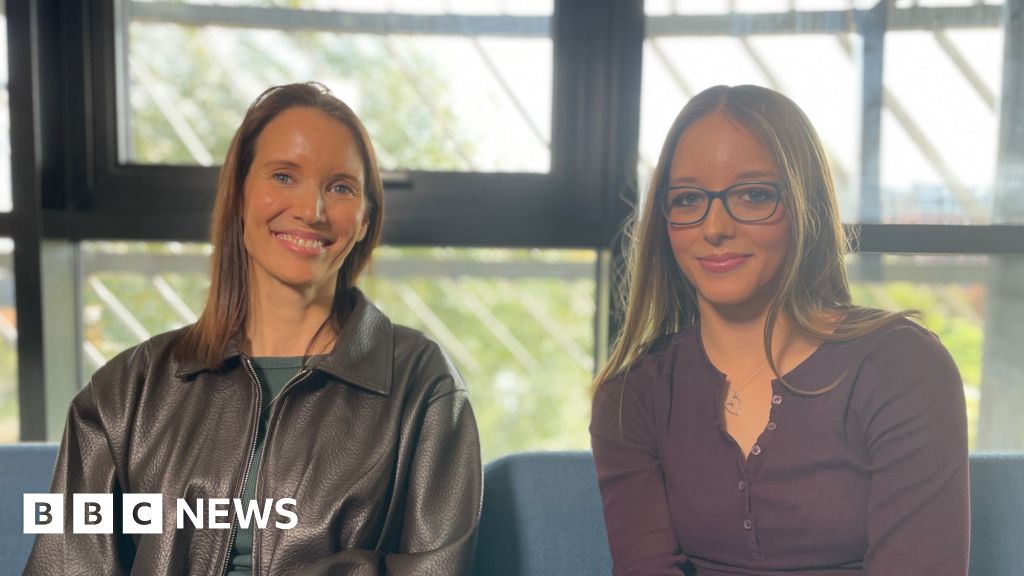
Site search 2 hours ago Navtej Johal Nottingham BBC Katie (right) and her mum Julia travelled to Nottingham from Hertfordshire to try out the device, which would help calm Tourette's symptoms When Katie was just a child, her tics were so relentless they left her bedridden with a sore throat for two weeks. The now 15-year-old says living with Tourette's affected her ability to sleep, eat, and caused her to miss school. Katie recalled trying it on for the first time, and said: "It was absolutely life-changing.
It was like the best day of my life." Tourette's syndrome is a neurodevelopmental condition with symptoms usually starting in childhood. Katie, from Hertfordshire, said she first started to experience symptoms aged seven. She said: "It was constantly moving, constantly making sounds and then I was kind of getting looked at like, 'why are you doing that?' "I used to make snorting sounds, but it was constant all the time, so I'd give myself a really bad sore throat and then be in bed for two weeks.
"I think I became quite sad a lot of the time." Katie's mum Julia said it was "heartbreaking" to see her daughter struggling. "You feel helpless. You feel you don't know where to turn really," she said.
She and Katie learned more about the device, and came to Nottingham to try it in December before it was available to buy. Katie said when she turned it on for the first time, the effect was "instant" and she became "really calm". "And I remember on the drive home, I just cried the whole way home because I was like, 'I want it now'," she said.
Prof Stephen Jackson, who has led the research, said seeing the impact on users of the device had been "a dream come true" Katie was among the first people to use the Neupulse device. It works by delivering electrical pulses to the median nerve at the wrist, which trials have shown can change the activity in the parts of the brain involved in movement control. They found that rhythmic stimulation can reduce the frequency and intensity of tics.
In 2023, a clinical trial of 121 people in the UK found they experienced, on average, a reduction in tic frequency of 25% while using a prototype of the device. The university added Capaldi was impressed by the effects of Neupulse and was eager to try it out again in the future. University of Nottingham Lewis Capaldi visited the team behind the device in 2023, prior to a gig in Nottingham The device was developed by the university and its spin-out company Neurotherapuetics Ltd, which secured £1m in additional funding to commercialise the device.
According to the Tourettes Action charity , there are two versions of the device: Neupulse-C - which is available as a consumer wellness device - and Neupulse-M, which is intended to be marketed as a medical device specifically for the treatment of tics and Tourette's syndrome, but it has not yet received regulatory approval for this purpose. Neupulse-M is still going through the regulatory approval process. It is hoped that if regulatory approval is obtained, the device will be considered for NHS use.
The charity added the National Institute for Health and Care Excellence (NICE) had identified the technology as "promising", and had requested further evidence of its long-term benefits before making recommendations over NHS adoption. The university said "thousands" of the devices had been sold so far. Prof Stephen Jackson, who has led the research, said seeing the impact on users of the device had been "a dream come true", and hoped it would be available on the NHS "in the next year or so".
He said: "We are working diligently and as hard as we can to get regulatory approval for the Neupulse device as a treatment for Tourette's. "It's been provisionally evaluated by the National Institute for Health and Care Excellence, but they were unable to recommend it for use in the NHS until we have the regulatory approval. That's something we're working towards." In 2025, NICE added: "Our committee will meet again to appraise the clinical and cost effectiveness of the technology and publish new guidance." According to Tourettes Action, more than 300,000 people in the UK have the condition, which is incurable.
Jackson said: "We've had people saying they managed to get through their wedding vows without ticking. "People saying they've been able to travel through the airport and travel on airplanes without ticking." The Neupulse-C is currently on sale as a wellness device Among the users is 15-year-old Ollie, from Cheshire, who started making involuntary neck movements nearly two years ago. "I just suddenly cracked my neck, and then about 48 hours after that, it was constant movements," he said.
"It was incredibly sudden." Ollie's dad, Alex, said daily tasks - including sleeping, eating and drinking - became "incredibly difficult", and said he and Ollie's mother were "at a loss... just watching our son deteriorate". "There's a period of it where I didn't leave the house for about a month," Ollie said. "I didn't hang out with my mates.
"Reading and writing became really hard. I was out of school for six, seven months as I'm getting into GCSEs." Ollie (left) and his dad Alex said the device was "life-changing" They heard about the device from the film I Swear , a drama based on the life of John Davidson, who is a Tourette's campaigner. The family initially thought Ollie had Tourette's syndrome, but he was later diagnosed with Functional Neurological Disorder (FND) - a neurological condition that affects how the brain and nervous system work.
At that point, he said he came close to telling his parents "probably don't bother with this device", because he did not think it would work. Alex said a few months ago, his son called them when he turned it on for the first time. "You could hear that he was crying on the telephone because it had worked and his neck movement had stopped," he said.
Ollie said: "It's like a light switch. I remember my hands were quite shaky when I was calling my parents because it's like getting part of your life back." They both said the gadget had been "life-changing". Mylo, who was involved in the clinical trials, said the device would make "such a big difference" Emma McNally, CEO at Tourettes Action, said users she had spoken to had given the device "nothing but praise".
"Some people have said it's helped them to go to places that they've not been for a long time, such as the cinema or a library. "Other people have said it's helped them when they've been in a tic attack to help them come out of that to calm the tics and make them feel more relaxed," she added. Mylo, 17, from Buckinghamshire, was involved in the clinical trial of the device in 2023 when he was 13.
He was recently given a device as a gift. When he switched it on for the first time, he said he "instantaneously" felt the need to suppress his facial tics "going". "As soon as it comes on, I can feel it," he said.
"I feel different... I feel new almost, which is strange. It's going to be such a big difference." The device has recently been tested in early trials for people with Parkinson's to see if it can be used to reduce tremors.
Prof Jackson said the university was also looking to launch a UK-wide clinical trial to look at both anxiety and obsessive-compulsive disorder (OCD). More on this story Related internet links
Source: BBC